
Research compiled for Rio Hondo's spring 2016 production of The Odd Couple.
Monday, February 8, 2016
Simply Simon: Not Just For Laughs
Link to a short, sweet, and juicy article on Neil Simon by everyone's friends over at PBS. It's put together to support a documentary on the playwright, but I can't seem to find it (at least not easily), if anyone finds it please push it my way.

Oscar and Felix, A New Look at The Odd Couple
Here is a review of "Oscar and Felix, A New Look at The Odd Couple," which, apparently was a thing in 2002, where Neil Simon updated the script to modern times, produced at the Geffen. I'm sure it would be interesting to see, but I'm glad we're doing the original.
Elliot Norton Reviews Art Carney
The following are excerpts taken from an interview of Art Carney (who played the original Felix Ungar) and a renown Boston theatre critic, Elliot Norton. It was filmed in 1973. I apologize that I cannot link the video to this blog as the video hosted on a protected database.
Elliot Norton Did he tell you anything about, what I as thinking about was the background. When you played in the Odd Couple, uh, you were playing, or were you playing one of the people that he knows? His brother is one of the characters in that play, isn't he?
05:00Art Carney (crosstalk) Yeah.
Elliot Norton Isn't that based on?
Art Carney He and Danny, yeah, his brother Danny.
Elliot Norton (crosstalk) Oh.
05:05Art Carney Uh, Neil...
Elliot Norton (crosstalk) Well, is Danny the part you played, the Felix Unger?
Art Carney (crosstalk) The lint-picker? The Felix Unger?I thi-, I don't know Danny too well. I would, I would think that, knowing Neil better than Danny, I would think that Neil would be, uh, now, I'm not quite sure, Elliot, whether it was, uh, whether he wrote the play about he and his brother, or it was his brother and another fellow, or Neil and another fella. I'm not quite sure about that. Uh, but of Neil and Danny, I would say, uh, Neil would be more the Felix Unger type.
05:35Elliot Norton Mm-hm.
Art Carney But Neil told me that when he did write the play, and after it got through with it, that he, that he did definitely have me in mind to do, to play Felix Unger.
05:45Elliot Norton Oh, really?
Art Carney Which, uh, pleased me and flattered me very much. Cuz, uh, I'd known Neil for a while, and, uh, he just, uh, he had seen me do several characters and things on the Gleason Show. I wasn't always the store-worker. We did various characterizations, and one of the characters in the Gleason Show was the fella at the lunch counter, Charlie Bratton, the loud-mouth, played by Gleason, and Clem Finch, the timid soul. And I think, maybe it was seeing me do that, uh, meek, timid sort of a fellow that gave Neil the idea that I'd be right for Felix, you know. Cuz I'm a lint-picker any-, anyway. I'm...
06:20Elliot Norton (crosstalk) Are you?
Art Carney You ea-. you saw me eatin' the sandwich in
there, and the potato chip fi-, I'm the kind of a fellow that after
you're through with the meal, and I'm like my mother, I go like this with the bread crumbs, you know. Which was Felix Unger.
06:30Elliot Norton Well, does, uh, has Neil Simon that close in, uh, following actors? I mean, is he that shrewd? Does he watching, in addition to writing plays, is he watching actors and thinking about them for parts? I mean, does he tend to cast plays as well as write them?
06:50Art Carney Yea. I, he has a lot, uh, a lot to do with the casting. Cuz when we were in the Odd Couple, uh, which was, as you know, directed by Mike Nichols, we, uh, rehearsed in New York for about three weeks, then we went out on the road. And, uh, Neil and Mike, constantly were, uh, working together. And Neilattended practically all rehearsals.
07:10Elliot Norton Mm-hm.
Art Carney And then he'd haul himself up at night and make changes, and, uh, we were floundering around in Wilmington, Delaware for an end to the play. And we had meet-, uh, I threw in things, uh, one night to, off the top of my head to see if we could search for an ending to the play. And, of course, as we were talkin' a little while ago up here with you, the two Pigeon sisters, the, those wonderful British gals, how you miss them an everything, and, uh, we brought them, Neil and, uh, and you and Mike (laughs) brought them back into the play.
07:45Elliot Norton Yeah.
Art Carney All for the better, too.
Elliot Norton Oh, yeah. That helped out a good deal, and it helped you, the character,
07:50Art Carney Oh, yeah.
Elliot Norton Felix Unger, comes out a whole lot better when the Pigeon sisters take him over in that particular part.
07:55Art Carney (crosstalk) That's right. That's, that's his victory over his, uh, loudmouth roommate.
---
and everything I have been saying thoughts that comes outta this fella's head. Neil Simon, nobody else, cuz he works alone. And I've known the fella for a long time. I know he's a sensitive, kind, uh, funny man. As I said before, the, uh, the things that happen in, in these two plays, I'm usingOdd Couple and Prisoner, are not funny at all.
09:55Elliot Norton No.
Art Carney You know, I mean, the, uh, the Odd Couple, two fellas thrown together, and unhappy marriages, and divorce, and everything, and goin' through hell. It's, uh, it was a sad situation, particularly for Felix.
---
Art Carney Because, uh, Neil Simon, uh, his writing is so, the only word I can think of is human. It is real, and Mike Nichols direction is so honest. In other words, he would always say to me, uh, and the other actor, "Don't worry about that laugh. Don't punch that line. You don't have to punch a line of Neil Simon's. It's there. You don't punch it to get that laugh." That, and Mike always said, this is difficult, "Try not to compare audiences." Andactors are human beings, right? Which you said in a column, (laughs) not log ago about me and my problems. That actors have problems, and so forth, and they get over them, and sometimes they don't. So, anyway, uh, it's very difficult for actors or actresses to, uh, to stop comparing audiences. Cuz when you have a house like you did last night, for example, and tonight maybe it won't be that, that strong, uh, you gotta numb yourself. And it's discipline, I guess, is the word. Just say, "Well, maybe they did enjoy it just as much." Or the Wednesday and Saturday matinee sometimes, in Chicago, they would be very quiet. And I'd say, "Well now just, you know, they might be enjoying it. Maybe there's not as many audible laughers out there." And at the end of that, that curtain call they were whooping itup, and, and you'd say something mean to yourself like, "Where were you when I needed you?" You know? But they loved it, you know.
Saturday, January 16, 2016
Neil Simon on the third act
The following is a link to an interview of Neil Simon speaking on the third act.
Mike Wood interviewed him on January 30, 1997.
If you take anything from short clip, I hope you recognize the amount of thinking that went into your lines! Some came easier than others, but each one had thought put into it.
As we rehearse, try to remember this when you are struggling to understand why you are saying something at a particular time.
Thank you to Caleb for sending this link our way!
-
4:55: And so I walked out dejected again realizing how difficult this playwrighting business is, cause you think you have it, and like quicksilver it's gone.
5:25: ...we put it in that night and we got huge laughs, even when the lines weren't that funny, cause the audience is now enjoying the sense of the comedy, the progression of the play, the characters coming into their own and learning something about theirselves...
Tuesday, January 12, 2016
On Neil Simon
Reading up on Neil Simon has given me insight not only into the man, but into the era of American Comedy that we're entering in performing this play. I hope you find these research notes as helpful as I do.
Your Show of Shows, a groundbreaking variety show, congregated some of the brightest young comedic writers, many of whom would help define the genre in the coming decades. It appears that types of shows appear in each generation; In Living Color and Saturday Night Live's contributors had a similar effect on their media as well.
Though none of his plays can be considered strictly autobiographical, Neil Simon never hesitated to draw from his own life for writing material. Knowing this, I think it's important to know a bit about the man's life to provide a frame of reference. He witnessed the divorce of his parents as a child, then experienced it first-hand in 1983.
Simon took a job in the Warner Brothers Manhattan office mailroom in the 1950s. After several years in this position, he quit Warner Brothers to begin writing with his brother, Danny Simon, on a full-time basis. The brothers wrote radio and television scripts for shows including the Sid Caesar series Your Show of Shows. The writing staff of this series included Mel Brooks, Woody Allen and Carl Reiner. -Biography.com
Your Show of Shows, a groundbreaking variety show, congregated some of the brightest young comedic writers, many of whom would help define the genre in the coming decades. It appears that types of shows appear in each generation; In Living Color and Saturday Night Live's contributors had a similar effect on their media as well.
Though none of his plays can be considered strictly autobiographical, Neil Simon never hesitated to draw from his own life for writing material. Knowing this, I think it's important to know a bit about the man's life to provide a frame of reference. He witnessed the divorce of his parents as a child, then experienced it first-hand in 1983.
While not entirely autobiographical, Simon makes no secret about using personal experiences or those of his friends for material. Come Blow Your Horn was about two brothers who moved away home and shared a bachelor apartment (just as Simon and his brother did);Barefoot in the Park was the story of newlyweds adjusting to married life (reminiscent of his own marriage); and, of The Odd Couple Simon once commented, "[the story] happened to two guys I know-I couldn't write a play about Welsh miners." -Encyclopedia.com
Sunday, January 10, 2016
Sidebar: Thinking Like a Director
Below are some excerpts from Michael Bloom's "Thinking Like a Director" that I hope you will find valuable, as actors, or any other kind of theater-maker.
-Michael
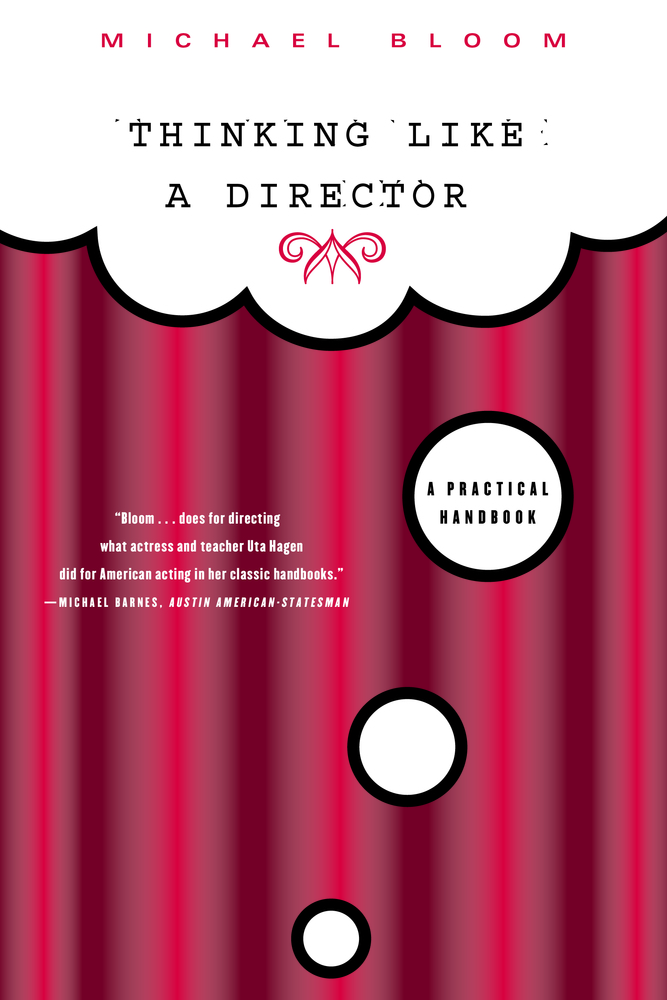
31: Interpretation rarely proceeds in an organized fashion.
32: Plays are webs of intentional behavior, action, the physical pursuit of a goal or desire, is the constant - and for most actors and directors, the clearest way into a text.
33: Action is most effectively understood and communicated as a transitive verb. Using intransitive verbs (Charcter x is angry about y) often promotes playing a condition or state of being instead of an action, and asking an actor to play a state of being more often than not produces generalized and artificial acting.
34: When you become specific about what a character wants in relation to another character [and look closely at what they are literally doing to get it], actable verbs emerge.
35: Determining exactly where and how a beat changes is a key matter of interpretation in a rehearsal process.
6: Determining a character's actions can be done only while simultaneously considering the given circumstances, which are often the catalysts that propel the character into action.
37: Less realistic plays, such as those of Shakespeare, Moliere, the Greeks, and many others, require actors and directors to invent given circumstances in addition to those mentioned in the text in order to connect and give context to the characters' actions.
(Think of the vibrant world - given circumstances - that Simon wrote into the The Odd Couple, a play in the style of realism.)
37: The motivation for a character's action is often found in the given circumstances.
40-41: An obstacle acts as a hard, resistant surface to the knife of action; it can brake, deter, or stimulate a character.
Obstacles can be posed internally by the character, or externally by other characters.
Sunday, January 3, 2016
Sidebar: The Actor and the Target
I recently purchased "The Actor and the Target" by Declan Donnellan, I director I know little about but regard highly. Just wanted to share some excerpts from the introduction that hopefully you might find helpful.
-Michael
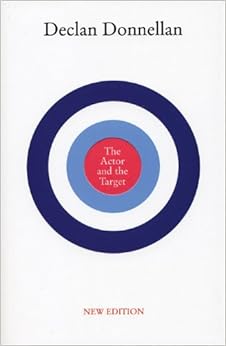
13: ...this is not a book about how to act; this is a book that may help when you feel blocked in your acting.
16: Rather than claim that ‘x’ is a more talented actor than ‘y’, it
is more accurate to say that ‘x’ is less blocked than ‘y’.
17: When acting flows, it is alive, and so cannot be analysed; but problems
in acting are connected to structure and control, and these can be
isolated and disabled.
20:
1. All the actor’s research is part of the invisible work, while the performance is part of the visible work.
2. The audience must never see the invisible work.
3. The rehearsal comprises all the invisible work and passages of visible work.
4. The performance consists only of the visible work.
21: The actor needs to accept the senses’ limitations in order for the
imagination to run free. The actor relies utterly on the senses; they
are the first stage in our communication with the world. The imagination
is the second.
21-22: The imagination is the capacity to make images... Only
the imagination can interpret what our senses relay to our bodies. It is
imagination that enables us to perceive. Effectively, nothing in the
world exists for us until we perceive it... Without our ability to make
images we would have no means of accessing the outside world. The senses
crowd the brain with sensations, the imagination sweats both to
organise these sensations as images and also to perceive meaning in
these images. We forge the world within our heads, but what we perceive
can never be the real world; it is always an imaginative re-creation.
Subscribe to:
Posts (Atom)